Fernando Alonso: From rookie to rookie
Early Career and Rise to Stardom
Fernando Alonso, born on July 29, 1981, in Oviedo, Spain, is widely regarded as one of the greatest Formula 1 drivers of all time. His journey to F1 began in karting, where he showcased immense talent from an early age. He made his debut in Formula 1 in 2001 with Minardi, a small team with limited resources. Despite an uncompetitive car, his performances caught the attention of key figures in the sport.
Renault and Back-to-Back Championships (2003-2006)
Breakthrough with Renault
Alonso’s big break came when he joined Renault in 2003. Under the guidance of Flavio Briatore and alongside an evolving team, he secured his first victory at the 2003 Hungarian Grand Prix, making him the youngest race winner at the time. Renault had been steadily improving, and Alonso was set to lead the team into a dominant era.
First World Championship (2005)
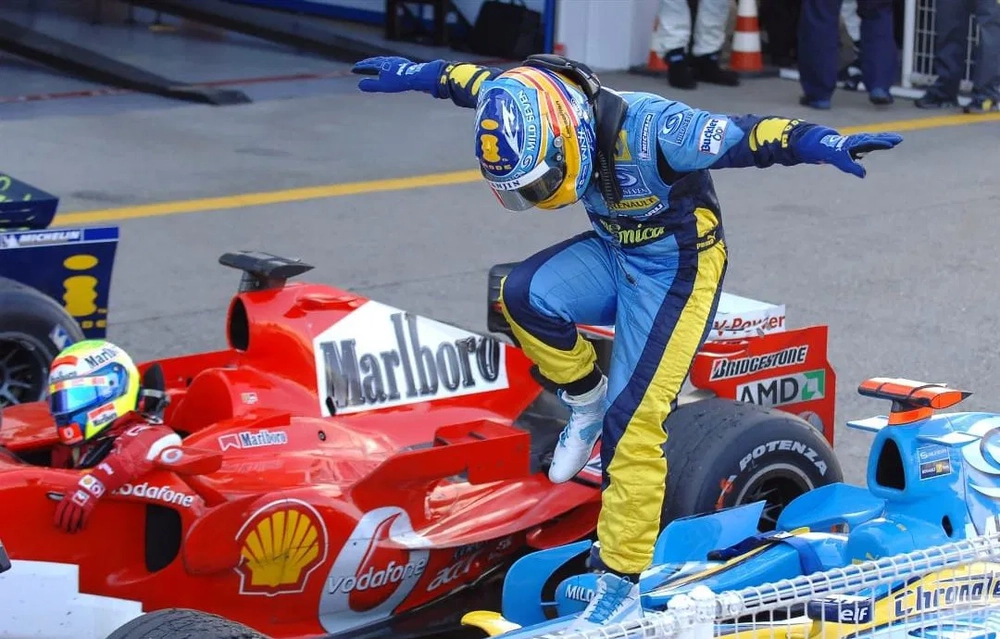
In 2005, Alonso capitalized on a competitive Renault R25 and became the youngest World Champion in history, breaking Michael Schumacher’s dominance. He won seven races that season and displayed remarkable consistency, securing the title ahead of Kimi Räikkönen and McLaren.
Defending the Title (2006)
In 2006, Alonso defended his title successfully despite fierce competition from Schumacher’s Ferrari. Key victories in Bahrain, Spain, and Japan helped him stay ahead in the championship battle. His triumph in 2006 cemented his status as a two-time world champion and Renault as a dominant force in F1.
Stints with McLaren and Ferrari (2007-2014)
McLaren: Internal Rivalry (2007)
After his championship-winning years at Renault, Alonso moved to McLaren in 2007, partnering with rookie Lewis Hamilton. The season was marked by intense internal rivalry, with both drivers finishing the season with equal points. The strained relationship with the team led Alonso to part ways with McLaren after just one season.
Return to Renault (2008-2009)
Alonso returned to Renault in 2008, where he won two races in Singapore and Japan. However, the team’s competitiveness had declined, and he struggled to fight for championships. In 2009, Renault faced controversies, including the infamous “Crashgate” scandal, leading Alonso to seek opportunities elsewhere.
Ferrari: The Nearly Man (2010-2014)
In 2010, Alonso joined Ferrari, aiming to restore the team’s championship-winning glory. He nearly won the title in his debut season with the team, only losing in the final race due to a strategic error in Abu Dhabi.
Alonso continued to fight for championships, finishing runner-up three times (2010, 2012, 2013). His 2012 season was particularly remarkable, as he almost clinched the title in an inferior car against Sebastian Vettel’s dominant Red Bull. Despite his consistent performances, Ferrari failed to provide him with a title-winning car, leading to his departure in 2014.
Return to McLaren and F1 Hiatus (2015-2020)
McLaren-Honda Struggles (2015-2018)
Seeking a new challenge, Alonso rejoined McLaren in 2015 as they partnered with Honda. The relationship was plagued by reliability issues and poor performance. His frustrations became evident, especially with his famous “GP2 engine” radio comment during the 2015 Japanese Grand Prix. Despite occasional flashes of brilliance, the project never lived up to expectations.
Debut in the World Endurance Championship (WEC)
Joining Toyota Gazoo Racing (2018-2019)
In 2018, Alonso made his debut in the World Endurance Championship (WEC) with Toyota Gazoo Racing, joining their LMP1 team alongside Sébastien Buemi and Kazuki Nakajima. His entry into endurance racing was highly anticipated, as few F1 drivers had successfully transitioned to WEC at such a high level.
24 Hours of Le Mans Victories
Alonso’s endurance racing career was an immediate success. In his first attempt at the legendary 24 Hours of Le Mans in 2018, he and his teammates secured victory, making him one of the few drivers to win the prestigious race on debut. The trio repeated their success in 2019, further solidifying Toyota’s dominance in the hybrid LMP1 era.
WEC Triumph
Beyond Le Mans, Alonso played a crucial role in Toyota’s 2018-2019 WEC season. His consistency and adaptability helped the team clinch the overall 2018-2019 FIA World Endurance Championship, proving that his talent extended beyond single-seater racing. His time in WEC showcased his ability to master endurance strategies, fuel management, and night driving—valuable skills that complemented his F1 expertise.
Aston Martin and Resurgence (2021-Present)
Comeback with Alpine (2021-2022)
Alonso made a sensational return to F1 with Alpine (formerly Renault) in 2021. He demonstrated that age had not diminished his talent, securing a podium in Qatar and playing a crucial role in the team’s development. His defensive driving against Lewis Hamilton in Hungary helped teammate Esteban Ocon secure an unexpected victory.
Aston Martin: A New Contender (2023-Present)
In 2023, Alonso moved to Aston Martin, surprising many with a competitive start to the season. Multiple podium finishes showcased his ability to extract the most from any car. His experience, racecraft, and tire management continue to make him a formidable competitor, proving that he remains one of the best drivers on the grid.
Legacy and Impact on Formula 1
Fernando Alonso’s career is a testament to resilience, adaptability, and pure racing skill. Despite not winning another title after 2006, his longevity and consistent performance across different teams and eras solidify his place among F1’s greatest drivers. With over 20 years in the sport, he remains a fan favorite and an inspiration to aspiring racers worldwide.