Jules Bianchi: The final tragedy that changed Formula 1 forever
Jules Bianchi was a supremely talented French racing driver whose career was tragically cut short due to a fatal crash during the 2014 Japanese Grand Prix. Tipped as a future Ferrari driver, Bianchi’s death in 2015 sent shockwaves through the world of motorsport and led to critical safety improvements in Formula 1.
Early Life and Career Beginnings
Born on August 3, 1989, in Nice, France, Jules Bianchi grew up in a family with deep motorsport roots. His grandfather, Mauro Bianchi, was a three-time world champion in GT racing, and his great-uncle, Lucien Bianchi, was a Formula 1 driver and the 1968 24 Hours of Le Mans winner. From an early age, it was clear that Jules was destined for racing.
His motorsport career began in karting, where he quickly made a name for himself as one of France’s brightest young talents. His rise through the junior ranks was meteoric:
- 2007: Won the French Formula Renault 2.0 championship, dominating the series with five wins.
- 2009: Won the F3 Euro Series with ART Grand Prix, joining the ranks of past champions like Lewis Hamilton and Sebastian Vettel.
- 2010-2011: Competed in GP2, securing multiple podiums and wins.
- 2012: Moved to Formula Renault 3.5, finishing second overall in the championship, behind Robin Frijns.
His performances caught the attention of Scuderia Ferrari, who signed him to their prestigious Ferrari Driver Academy in 2009. This connection would later bring him closer to achieving his F1 dream.
Journey to Formula 1
Bianchi’s entry into Formula 1 began as a test driver for Ferrari in 2011. The following year, he served as the reserve driver for Force India, gaining valuable experience with a midfield team.
In 2013, Bianchi secured his first full-time F1 seat with the backmarker team Marussia, after a last-minute deal fell through for Luiz Razia. Despite driving an underpowered car, Bianchi impressed with his raw speed and racecraft. His rookie season saw him consistently outperform his teammate, Max Chilton, and demonstrate flashes of brilliance that hinted at a promising future.
2014 was a pivotal year for Bianchi. While still with Marussia, he was widely considered the next in line for a Ferrari seat if Kimi Räikkönen or Fernando Alonso were to leave.
The 2014 Monaco Grand Prix – A Historic Performance
Bianchi’s defining moment came at the 2014 Monaco Grand Prix, where he achieved the impossible—scoring points in a Marussia car.
- Despite starting 21st on the grid due to a penalty, Bianchi fought his way through the field on the tight streets of Monte Carlo.
- He finished ninth, earning Marussia’s first and only points in Formula 1 history.
- The result proved his exceptional talent, as he outperformed far superior machinery on one of the most challenging circuits on the calendar.
This performance solidified his reputation as a future star, with many believing it was only a matter of time before he would race in Ferrari red.
The Tragic 2014 Japanese Grand Prix Accident
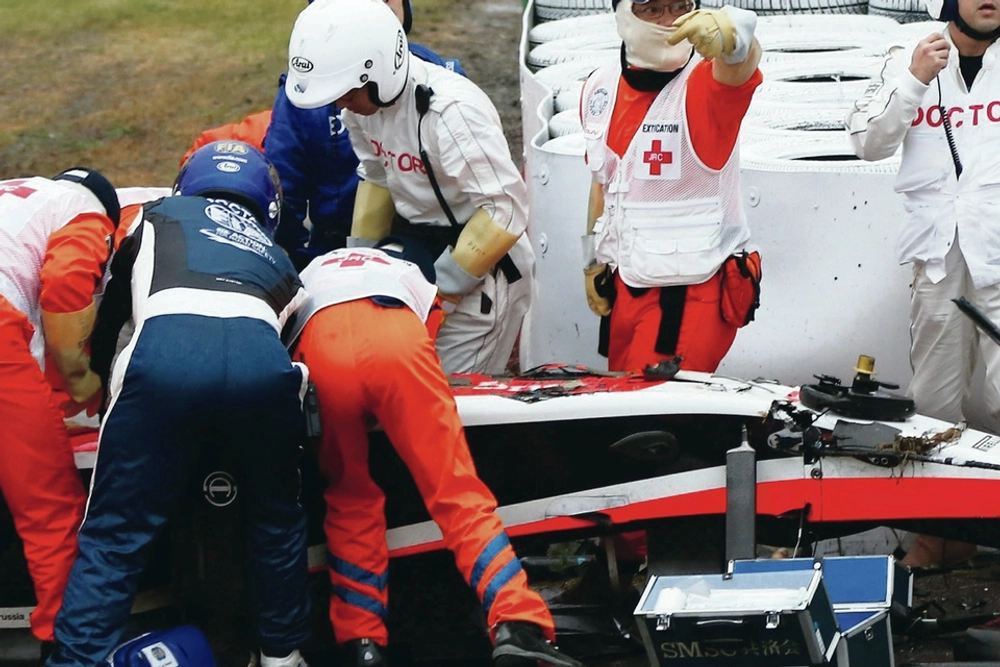
On October 5, 2014, during the Japanese Grand Prix at Suzuka, heavy rain from Typhoon Phanfone made conditions treacherous. Late in the race, Adrian Sutil crashed at Turn 7, bringing out a recovery vehicle to clear his stricken Sauber.
On the next lap, Bianchi lost control at the same spot, aquaplaning off the track and slamming into the recovery vehicle at high speed. The impact caused severe head trauma, and Bianchi was immediately rushed to the hospital. He remained in a coma for nine months, but tragically, on July 17, 2015, he passed away at the age of 25.
Bianchi was the first Formula 1 driver to die as a result of race injuries since Ayrton Senna in 1994. His accident shook the motorsport world and led to critical safety reforms.
Legacy and Safety Improvements in Formula 1
Bianchi’s accident led to several changes in F1’s safety regulations, aimed at preventing similar tragedies:
- Virtual Safety Car (VSC): Introduced in 2015 to slow down cars during yellow flag conditions, preventing high-speed incidents near crash sites.
- Stricter Double Yellow Flag Rules: Drivers are now required to slow significantly under double-waved yellow flags.
- The Halo Cockpit Protection System: Implemented in 2018, the Halo has already saved multiple lives, including Charles Leclerc (2018 Belgian GP) and Lewis Hamilton (2021 Italian GP).
The FIA also retired Bianchi’s number 17 from Formula 1 in his honor—one of the few times this has happened in the sport’s history.
Jules Bianchi’s Lasting Impact
Though his life was tragically short, Jules Bianchi’s influence on Formula 1 remains significant. His legacy lives on through:
- Charles Leclerc, his godson, who has since joined Ferrari, fulfilling the destiny many believed Bianchi was set for.
- The safety improvements that continue to protect drivers today.
- His legendary Monaco 2014 performance, which remains a testament to his skill.
Jules Bianchi was more than just a promising driver—he was a symbol of perseverance, talent, and passion for motorsport. Though he never had the chance to fulfill his potential, his impact on Formula 1 will never be forgotten.
“Jules was supposed to be in Ferrari, not me. I will race for both of us.” – Charles Leclerc